The Mathematics of Progressive Jackpots: When the Odds Actually Favour You
KingCasinoBonus.com receives money from casino operators every time someone clicks on our links, influencing product placement. However, the compensation we receive does not influence our evaluation process, analysis and recommendations. We always provide objective, honest verdicts to support informed choices.

Progressive jackpots usually favour the house, but there’s a mathematical tipping point where the odds shift in your favour. Understanding when jackpots reach this threshold could transform these games from entertainment expenses into calculated opportunities.
On this page
- Why 95% of Progressive Jackpot Players Get the Math Wrong
- The Three Flavours of Progressive Jackpots
- Cracking the Breakeven Point
- Timing Tricks: When to Jump In
- Psychology vs. Mathematics: The Classic Trap
- Playing Smart: A Mathematical Toolkit
- Players Ask: Common Jackpot Questions
- Final Thoughts: Know the Odds, Enjoy the Ride
Why 95% of Progressive Jackpot Players Get the Math Wrong
People tend to think a bigger jackpot equals a better deal. Wrong. A £10 million pot isn’t automatically better than a £2 million one. The real question is whether the jackpot size is enough to offset the terrible base return-to-player (RTP) on most progressive slots.
Progressives RTP Disadvantage
Regular slots sit around 94–98% RTP. Progressives, on the other hand, are usually in the 88–92% gutter because 1–5% of every bet is siphoned off to feed the jackpot. That missing bit is not only what makes the pot balloon but also what chews through your bankroll faster.
So when does it turn around? When the jackpot gets so bloated that its contribution to expected value tips the scale. For Mega Moolah, for example, that breakeven point is around £15–20 million. Only when it creeps over £25 million does the math really start smiling at you. But even then, the odds are still roughly 1 in 50 million.
The Three Flavours of Progressive Jackpots
Not all jackpots are brewed the same. There are three main types, and knowing the difference matters.
- Standalone Progressives: These are like local raffle draws. One machine, one pool, limited growth. They rarely go past £50,000, and the math almost never tilts your way. But at least they’re predictable and transparent.
- Local Area Progressives: Linked across multiple machines in one casino. Jackpots usually land between £10,000 and £500,000, with odds in the 1-in-500,000 to 1-in-5 million range. Better than standalones, but still unlikely to change your life.
- Wide Area Networks: The big leagues. These jackpots are fed by hundreds of casinos and thousands of players. Think Mega Moolah. They can soar past £20 million. Occasionally, they cross into positive expected value. But the odds? Still in lightning-strike territory.
The takeaway: wide-area progressives are the only ones that ever mathematically favour you — but variance is brutal, and the edge is collective, not personal.
Cracking the Breakeven Point
So how do you know when a jackpot actually flips in your favour? It comes down to a simple formula:
(Jackpot × Win Probability) + Base RTP – 1
If the number is above zero, congratulations — the math favours you.
The catch? Casinos don’t exactly hand out win probabilities on a silver platter. Most of the time you’re reverse-engineering from scraps of public data. But analysts have done the legwork, and here’s what it looks like:
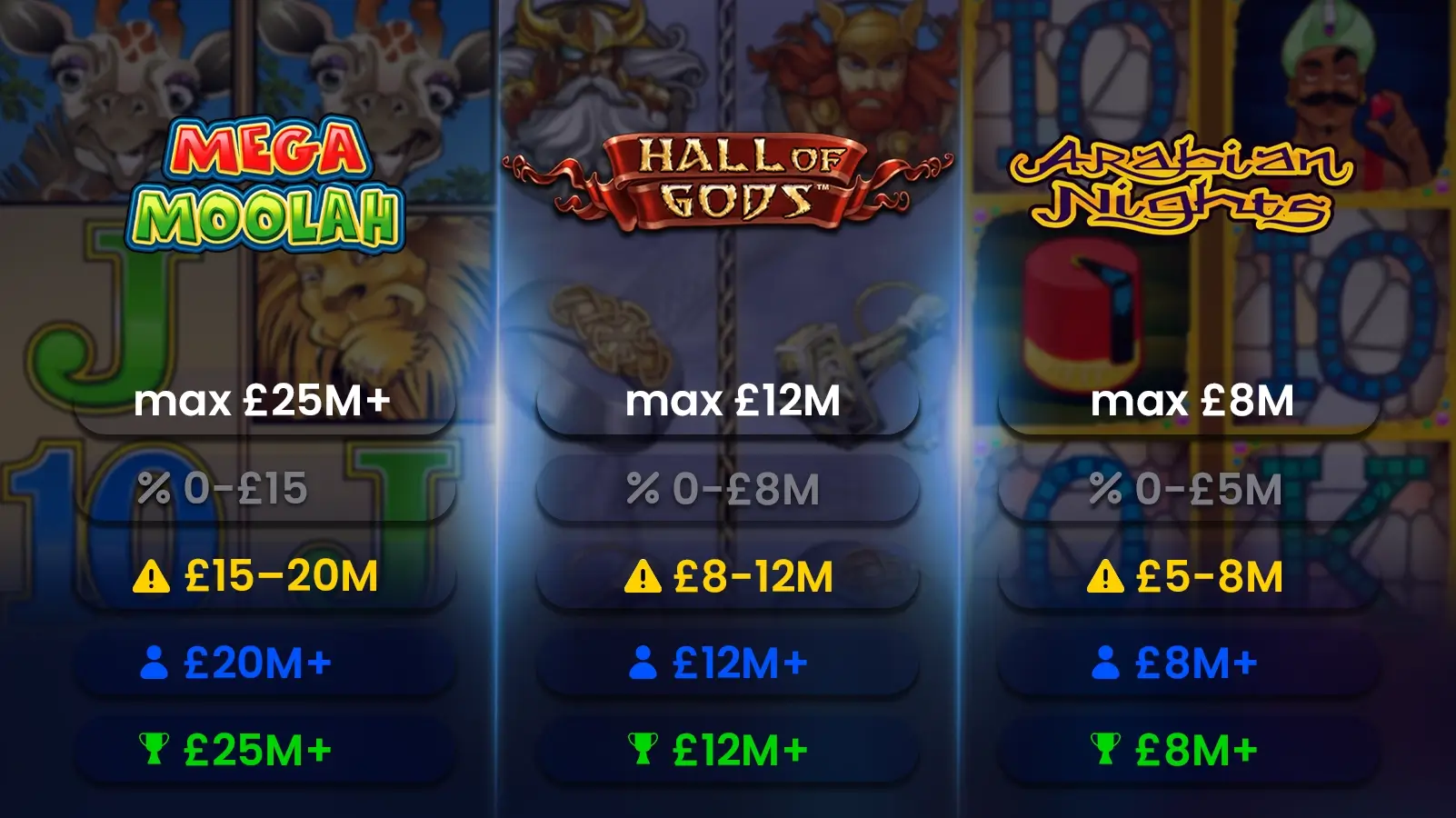
- Mega Moolah: Neutral at ~£15–20M, positive at ~£25M+
- Hall of Gods: Neutral at ~£8–12M
- Arabian Nights: Neutral at ~£5–8M
Even when the math says “go,” the variance is still sky-high. You could play until your hair goes grey without hitting it. The “player advantage” exists in theory, not in your personal spin history.
Timing Tricks: When to Jump In
While there’s no magic hour to win, certain timing strategies can improve your value.
- Must-Hit-By Jackpots: These are the jackpot equivalent of an expiry date. If the game says it must hit before £10,000, and it’s already at £9,500, the expected value skyrockets. You’re basically betting on borrowed time.
- Reset Cycles: Big progressives often follow patterns. They reset low, grow quickly in the first month or two, then hover in “vulnerable” territory in months 3–6. That’s when breakeven levels are more likely to appear.
- The trade-off? When jackpots balloon, so does player traffic. More competition means your individual odds don’t improve — the pool just grows faster until someone, somewhere, scoops it.
Psychology vs. Mathematics: The Classic Trap
Here’s why most players ignore the math: our brains are wired for stories, not probabilities.
- Availability Heuristic: You read a headline about a £15M jackpot winner and think, “It happens all the time.” Reality check: your odds are worse than being struck by lightning twice in one week.
- Gambler’s Fallacy: “It hasn’t hit in ages, so it must be due.” Nope. Each spin is an independent coin flip. The universe doesn’t keep a jackpot calendar.
- Sunk Cost Fallacy: “I’ve already spent £500 chasing this, I can’t quit now.” Bad news: past spins don’t matter. The odds are the same whether you’re in for £5 or £5,000.
Casinos know this and design progressives to keep you hooked. Flashing jackpot counters, winner announcements, “almost there” vibes — it’s all psychology working against you.
Playing Smart: A Mathematical Toolkit
If you’re going to dabble in progressives, do it with math on your side:
- Bankroll Discipline: High variance means you need at least 1,000x your usual bet size if you’re serious. Casual players? Keep sessions capped at 2 hours max.
- Bet Sizing: Max bet isn’t always best. Check the rules — sometimes smaller bets still qualify for the jackpot but bleed less on the base game.
- Game Selection: Don’t chase jackpots just because they’re huge. Compare base RTP, reset values, and historical averages. Sometimes a mid-tier jackpot offers better math than the flashy mega-pool.
Players Ask: Common Jackpot Questions
Why do some jackpots hit more often than others?
Because network size matters. Small networks with higher contribution rates pop more frequently with smaller payouts. Big networks build massive pots but take forever to trigger.
Can casinos control when jackpots drop?
Nope. They use certified RNGs with fixed odds. What they can control are eligibility rules. Always double-check you’re betting enough to qualify before chasing.
Are record-high jackpots the best time to play?
Sometimes yes, sometimes no. The math improves with bigger pots, but so does competition. A record jackpot attracts hordes of players, and while someone will win, your personal odds don’t actually improve.
Do odds change by time of day?
Nope. RNG doesn’t care if it’s 3 a.m. or lunchtime. The only thing that changes is jackpot growth speed — faster at peak hours, slower overnight.
Should I always max bet?
Not automatically. Run the numbers. Sometimes smaller bets qualify just fine and give you better long-term value. Don’t assume “max” equals “smart.”
Final Thoughts: Know the Odds, Enjoy the Ride
Progressive jackpots are catnip for dreamers. And occasionally, if you know how to crunch the numbers, they tip into positive expected value. But remember: that “edge” exists in theory over millions of spins, not your Saturday night session.
If you choose to play, treat it like entertainment with a side order of math nerdery. Set limits, ignore the psychological bait, and only jump in when the jackpot size truly makes sense.
Because yes, jackpots can be life-changing. But the real win is knowing when the house edge actually slips — even if just for a moment — and walking in with eyes wide open.